A1 Distribution CenterAI. Security. Connection.

THE IDEAS BEHIND TODAY’S TECHNOLOGY

From early computers
to artificial intelligence.

Today’s AI grew from generations of progress in computing, software, and the ways people work with information.

Explore the milestones—and the connection between the machines that follow instructions and systems trained to recognize patterns.

Explore the Timeline ↓
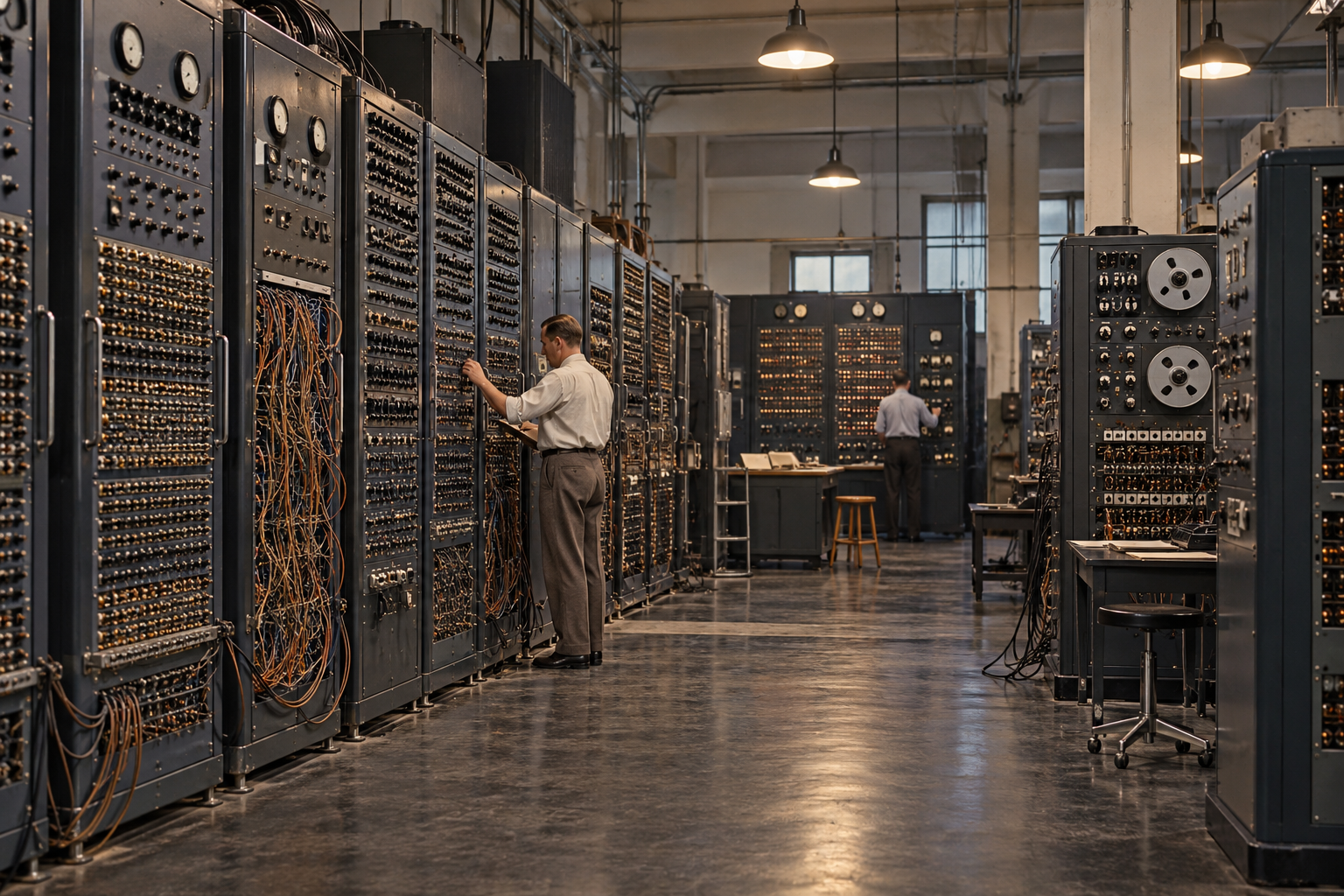
Illustrative reconstruction of an early computer room with cabinets and technicians
AI-generated historical reconstruction; not an archival photograph or a specific historical machine.

A SHORT HISTORY

Smaller machines.
Bigger possibilities.

1830s–1840s

The idea of a programmable machine

Charles Babbage developed the concept of the Analytical Engine, a mechanical programmable computer. Ada Lovelace’s notes explored its broader potential. The complete machine was not built in their lifetimes. Discover the early ideas ↗

1940s–1950s

Electronic computing takes shape

Early electronic computers used large assemblies of components to perform calculations. ENIAC, publicly introduced in 1946, demonstrated the potential of general-purpose electronic computing. Explore the museum timeline ↗

1956

AI becomes a research field

The Dartmouth summer research project helped establish artificial intelligence as a field. Researchers explored whether machines could perform tasks associated with human intelligence. Read Stanford’s AI history ↗

1960s–1980s

Computers become more accessible

Transistors, integrated circuits, and microprocessors helped make computers smaller. Personal computers brought programmable tools into more offices, schools, and homes. See the computing milestones ↗

Connected computing

Information moves beyond one machine

Networks and the web made sharing information central to computing. Connected systems became a foundation for online services, collaboration, and access to computing resources. Explore networking history ↗

Learning from data

Patterns become part of the program

Machine-learning systems use examples to fit models rather than relying only on hand-written rules. Advances in data, algorithms, and computing helped expand applications in language and images. Explore AI’s development ↗

2017 onward

A new foundation for language tools

The 2017 paper Attention Is All You Need introduced the Transformer architecture. It became an important foundation for many modern language models. Read the original research ↗

Illustrative modern computing infrastructure with server racks and network cables
Illustrative image of modern computing infrastructure.

WHAT CHANGED?

From instructions
to learned patterns.

Traditional software follows instructions people define. A machine-learning model is trained to identify patterns in examples and apply those patterns to new inputs. Many useful products combine both approaches.

Generative AI can produce new text, images, or other outputs. That makes it a useful tool to explore, but its answers still need review: a convincing response can contain mistakes.

For a business, the practical question is simple: where can a carefully tested tool help your team do useful work?

Explore Technology & Innovation ↗

Progress works best with perspective.

Computing history includes many contributors and competing approaches. This overview highlights a few milestones; it is not a claim that one invention or company created today’s AI alone.

Talk with A1 about your technology goals ↗